
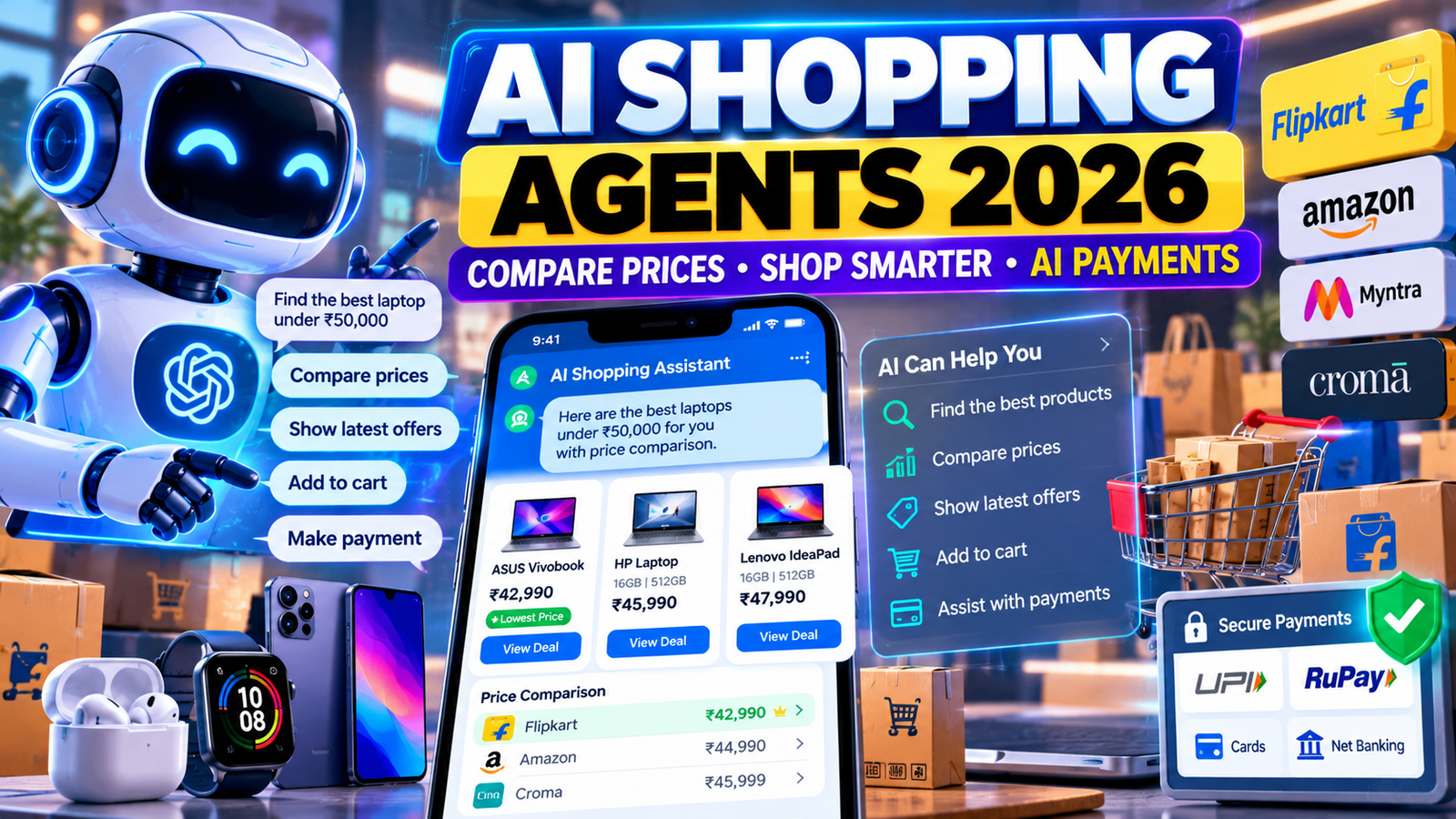
AI Shopping Agents in India 2026: How AI Can Shop, Compare Prices & Make Payments for You
Updated: October 27, 2026 | Category: Technology & Shopping
Online shopping in India is entering a new phase. Artificial intelligence can now help customers discover products, compare prices and make better buying decisions.
The next step is even more interesting. AI shopping agents are being developed to complete purchases on behalf of customers.
AI Shopping Agents in India 2026 could change how people shop on platforms such as Flipkart and other online stores.
Instead of browsing multiple websites, shoppers may eventually complete an entire purchase through a conversation with an AI assistant.
Google is already testing a shopping experience that connects Gemini and Google Search’s AI Mode with Flipkart checkout.
Meanwhile, Indian payment companies are developing technology for AI-assisted transactions.
However, fully autonomous AI shopping is not yet available to every Indian consumer.
Here is how AI shopping agents work, what is available today and what could change next.
What Are AI Shopping Agents?
An AI shopping agent is an intelligent digital assistant that helps users complete shopping-related tasks.
Traditional search engines display products based on keywords. AI shopping agents take a more conversational approach.
For example, a customer might ask:
“Find a smartphone under ₹20,000 with a good camera, long battery life and 5G support.”
An AI assistant can analyse those requirements and suggest suitable products.
It may also explain differences between models and help the customer compare important features.
More advanced systems can connect with online retailers to check product availability and prepare purchases.
Some emerging systems can also support checkout and payment workflows.
However, these capabilities depend on the shopping platform, payment provider and permissions available to the user.
AI recommendations do not always reflect live prices or inventory. Therefore, customers should verify important details before buying.
How AI Shopping Agents Work in India
AI-powered shopping usually involves several stages.
1. Understanding Your Requirements
First, the AI assistant analyses your request.
You can describe your budget, preferred brand, product category and important features.
For example, you might ask for a washing machine suitable for a family of four.
The AI can use these requirements to narrow the available options.
2. Finding Suitable Products
Next, the assistant searches connected product catalogues or available shopping information.
It may identify products that match your budget and preferences.
However, access to live product listings depends on the AI service and retailer integrations.
3. Comparing Prices and Features
AI can organise product information into a simple comparison.
It may highlight differences in specifications, warranty terms, ratings and prices.
This can reduce the time spent comparing multiple products manually.
Still, the lowest displayed price may not include shipping charges or other costs.
4. Preparing the Purchase
An integrated shopping agent may help select a product and prepare the checkout process.
Some platforms are testing ways to complete purchases within an AI interface.
Other services still redirect customers to the retailer’s website.
5. Completing Payment
Payment is the most sensitive part of AI shopping.
Some systems require customers to approve each transaction. Others are exploring pre-authorised payments within defined limits.
In India, wider use of autonomous UPI payments remains subject to regulatory and security requirements.
Therefore, users should never assume that an AI assistant can independently access their bank account.
Google Gemini and Flipkart: AI Shopping in India
One of the most important developments involves Google and Flipkart.
In September 2026, reports revealed that Google was testing direct Flipkart purchases through Gemini and AI Mode.
Selected users could see a Buy button beside eligible Flipkart products.
The button opened a Flipkart checkout experience within Google’s AI interface.
The early trial focused on a limited selection of products. These included smartphones, electronics and mobile accessories.
However, the feature was not available to every user.
Google also did not confirm a nationwide launch date.
This experiment demonstrates how AI shopping could move beyond product recommendations.
Instead of simply suggesting a product, an assistant could help customers complete the purchase.
For Indian shoppers, such integrations may eventually reduce the need to switch between multiple applications.
Can AI Shopping Agents Compare Prices Automatically?
Yes. AI assistants can help compare product prices and specifications when they have access to reliable shopping information.
For example, imagine that you want to purchase wireless earbuds under ₹3,000.
You could ask an AI assistant to compare models based on battery life, microphone quality and warranty coverage.
The assistant may organise the available information into a comparison table.
It could also explain which features matter most for your requirements.
However, accurate price comparison requires current data.
Prices often change during sales, promotional events and limited-time offers.
Additionally, different sellers may charge different delivery fees.
For this reason, customers should confirm the final checkout price before placing an order.
AI is useful for narrowing choices. It should not replace checking the seller, warranty and return policy.
Can AI Make UPI Payments for You?
India is exploring new payment infrastructure for AI-powered transactions.
The concept is known as agentic payments.
Under this model, a customer may authorise an AI agent to make certain payments within predefined conditions.
For example, a user might allow a shopping assistant to purchase essential groceries within a fixed spending limit.
The assistant could then complete eligible transactions without asking for approval every time.
However, such systems need strong safeguards.
These include spending limits, identity verification, transaction records and controls for cancelling access.
In June 2026, Pine Labs announced its Payment Protocol, called P3P, for AI-powered UPI payments.
The company described it as a system that allows authorised AI agents to complete supported UPI transactions.
Meanwhile, reports indicated that NPCI was developing a broader Unified Agent Protocol for agent-led UPI payments.
In September 2026, Business Standard reported that the proposed protocol had been temporarily put on hold while additional safeguards were considered.
Therefore, AI-powered UPI payments should not be treated as a standard feature available across all Indian banking and shopping apps.
Customers should rely on verified payment integrations and review every permission carefully.
Google Universal Commerce Protocol: Why It Matters
Google introduced the Universal Commerce Protocol, or UCP, in January 2026.
It is an open standard designed to help AI assistants communicate with retailers and payment services.
The protocol supports different parts of the shopping journey.
These include product discovery, cart management, checkout and order handling.
Google has also introduced its Universal Cart concept.
The goal is to make shopping more convenient across participating retailers and Google services.
However, UCP-powered checkout availability depends on participating merchants and supported regions.
Google’s published merchant guidance currently identifies specific eligible markets outside India.
Therefore, Google’s broader UCP plans should not be confused with confirmed nationwide availability in India.
The reported Flipkart trial is a separate example of AI-assisted checkout being tested for Indian users.
Benefits and Risks of AI Shopping Agents
AI shopping agents may offer several benefits.
They can simplify product research and reduce repetitive browsing.
They may also help customers compare technical specifications in plain language.
Additionally, integrated checkout systems could make online purchases more convenient.
However, these tools introduce important risks.
AI assistants may display outdated prices or incomplete product information.
Some recommendations may overlook seller reliability, delivery charges or warranty conditions.
There are also privacy concerns when shopping agents access personal preferences, addresses and payment permissions.
Autonomous payments create additional risks if an agent misunderstands instructions.
For example, an incorrect product selection could lead to an unwanted purchase.
Therefore, users should choose trusted services and review their account permissions regularly.
They should also set spending limits wherever supported.
Most importantly, customers should avoid sharing UPI PINs, passwords or one-time passwords with AI chatbots.
How to Use AI for Smarter Online Shopping
You do not need a fully autonomous shopping agent to benefit from AI today.
Start by using an AI assistant for product research.
Describe the product you want, your budget and the features that matter most.
For example, you can ask:
“Compare three 5G smartphones under ₹15,000 in India. Focus on battery life, camera quality and software updates.”
Next, review the suggested products.
Check their current prices on trusted retailer websites.
Read recent customer reviews and confirm warranty coverage.
You can also ask the AI to explain confusing specifications.
Once you have selected a product, complete the purchase through a trusted checkout process.
If an official AI-integrated checkout is available, review the merchant and payment details before confirming.
This approach combines AI-powered research with human control over spending.
Frequently Asked Questions
1. What are AI shopping agents?
AI shopping agents are digital assistants that help users find products, compare options and complete supported shopping tasks.
2. Are AI shopping agents available in India in 2026?
AI-assisted product research is available. However, advanced purchasing and autonomous payment features remain limited to supported services and trials.
3. Can ChatGPT compare shopping prices?
ChatGPT can help compare products and available price information. However, live pricing depends on the tools and shopping sources available.
4. Can Google Gemini buy products from Flipkart?
Google has reportedly tested Flipkart checkout within Gemini and AI Mode for selected Indian users. Wider availability has not been confirmed.
5. Can AI automatically make UPI payments?
Specialised agentic payment systems are emerging. However, autonomous UPI payments are not universally available across Indian apps.
6. Are AI shopping agents safe?
Safety depends on the provider, permissions and payment controls. Users should verify prices, merchants and transaction details.
7. Will AI shopping replace online shopping apps?
AI may simplify how customers discover and purchase products. However, retailer apps and websites will continue to play important roles.
Conclusion
AI Shopping Agents in India 2026 represent an important shift in online shopping.
AI assistants already help consumers research products, compare features and make informed buying decisions.
Meanwhile, Google, Flipkart and payment technology companies are exploring more advanced shopping experiences.
These developments could eventually allow customers to discover products and complete authorised purchases through a single conversation.
However, autonomous shopping and UPI payments remain limited by platform availability, security requirements and regulatory developments.
For now, the most practical approach is to use AI for product research while keeping control over final purchases.
As new integrations become available, AI shopping could become a more familiar part of India’s digital economy.
Disclaimer: This article provides general technology and shopping information. Features, availability and payment requirements may change. Always verify transaction details through official services.